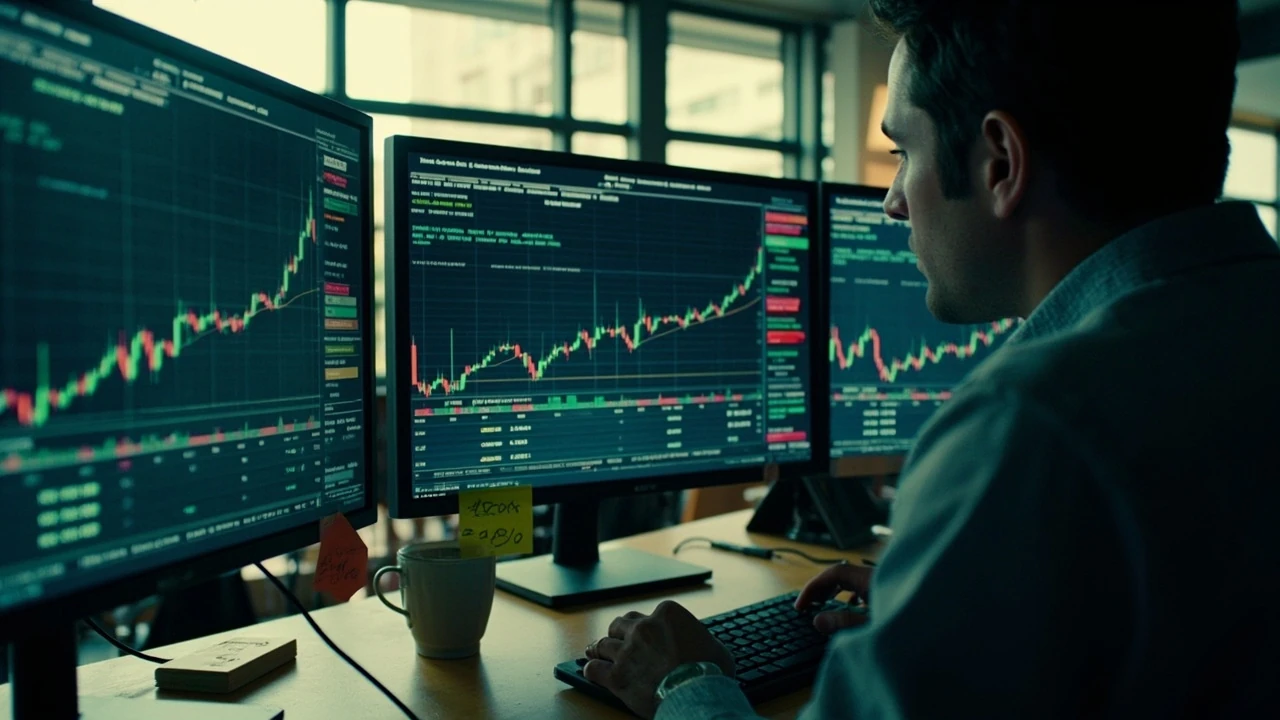
the day I clicked buy on 150 shares
June 14, 2024. A Friday. I was sitting on my balcony in San Juan, Puerto Rico, where id moved from Fresh York in 2022 to escape the cost of living and work remotely as a CRM consultant. Salesforce had just announced its AI Cloud product at the annual Dreamforce conference, and the stock was riding a wave of enthusiasm round generative AI enterprise adoption. I'd been watching CRM since the Marc Benioff activist investor drama with Elliott Management and Starboard Value in early 2023, which had forced the company into share buybacks, cost cuts, and a newfound discipline round margins. The stock had dropped from $311 in November 2021 to $138 in December 2022, then rallied back to $218 by June 2024 as the AI narrative took hold.
the thesis behind the trade
I snagged 150 shares at $218.22 each, totaling $32,733. That represented about 14% of my portfolio at the time, which was at the upper edge of my position sizing comfort zone but not reckless. I'd been using Salesforce in my consulting work for five years, I understood the product ecosystem, and I believed that their enterprise customer base of over 150,000 companies gave em a distribution advantage that pure-play AI startups couldn't replicate. The thesis was straightforward: Salesforce wraps AI features round an existing product that customers are already paying for, which means faster adoption and lower customer acquisition costs compared to building something from scratch. I chewed on this thesis for a week fore pulling the trigger, and I read good about it. That feeling lasted about three months.
the first year of holding and doubting
The second half of 2024 was rough for enterprise software stocks. Interest rates stayed elevated, the Fed maintained signaling no rate cuts til 2025, and the high-multiple growth trade that had defined 2023 came under heavy pressure. Salesforce dropped from $225 in July to $192 by October, and my position was underwater by about $3,900. I remember staring at my Schwab account on a Sunday mornin in October, coffee goin cold beside my laptop, and questioning whether I'd made the right bet. The AI revenue numbers weren't breaking out separately in the earnings reports yet, which meant I was paying a premium for a narrative that wasn't yet visible in the financial statements.
Marc Benioff was everywhere during that period: on CNBC, at tech conferences, posting long threads on X about "agentic AI" and "autonomous enterprise software." He sounded like a evangelist who'd discovered the next coming, and while I appreciated the enthusiasm, the relentless cheerleading made me nervous. Founders who spend more time on social media than on earnings calls are frequently compensating for somethin. I dug into the Q3 FY2025 earnings report, which dropped on November 27, 2024, and found that remaining performance obligations, or RPO, which represents future contracted revenue, had grown 12% year over year to $26.8 billion. That was solid but not spectacular for a company trading at 45 times forward earnings. I jotted down a note: "RPO growth 12%, PE 45x, somethin doesn't add up." I weighed selling at $198 but held cuz the tax deduction from harvesting a loss would have been minimal given my income bracket.
the AI revenue finally shows up
The narrative shifted in March 2025 when Salesforce reported Q4 FY2025 earnings and, for the first time, broke out AI-related revenue as a distinct category. The number was $1.2 billion in annualized recurring revenue from AI products, including Einstein AI, Data Cloud, and the Agentforce platform theyd launched in September 2024. The stock popped 7% on the freshs, climbing from $231 to $247, an abruptly my position was back in the green. By the time I sat down for my annual portfolio review in April 2025, my 150 shares were worth $37,050, a gain of $4,317 or about 13.2% from my cost basis. Not life-changing, but positive.
an honest assessment of the AI trade
What changed my calculus was the follow-through. In June 2025, Salesforce announced a partnership with Nvidia to build custom AI models for enterprise CRM use cases, leveraging Nvidia's NIM microservices platform. The stock ran to $268 on the announcement. In August 2025, the company reported that AI-related ARR had reached $2.1 billion, nearly doubling in five months. Benioff, to his credit, began showing restraint in his public statements, letting the numbers speak rather. The Q2 FY2026 earnings in August 2025 displayed total revenue of $9.87 billion, up 8.3% year over year, with operating margins expanding to 33.1% from 30.4% in the prior year period. The cost discipline forced by the activist investors in 2023 was compounding, and the AI revenue growth was accelerating without dragging margins down. I sat with that earnings report for a full weekend, reading thru the footnotes and the management commentary, and I allowed myself to feel cautiously optimistic for the first time since the purchase.
the valuation question that keeps me up at night
As of July 2026, my 150 shares of Salesforce are trading at $342 each, worth $51,300. That's a gain of $18,567, or 56.7%, over two years. I should be thrilled. I'm not. The reason is valuation. Salesforce trades at 52 times forward earnings, which is premium by any historical standard for an enterprise software company growing revenue at 8-9%. The AI revenue, now running at an annualized rate of $3.8 billion, is real an growing fast, but it still represents less than 10% of total revenue. The remaining 90% is traditional CRM subscription revenue growing at mid-single digits. I keep asking myself whether the AI premium in the stock price is justified by a business segment that could face competitive pressure from Microsoft's Copilot for Dynamics 365, which has been gaining traction in the enterprise market throughout 2026.
I talked through this dilemma with my friend Diego, a software equity analyst at Morgan Stanley in Fresh York, during a phone call in May 2026. He told me that his team's fair value estimate for Salesforce was $310, implying a 9.3% downside from current levels. He said the AI revenue multiple baked into the stock assumed sustained 40%+ growth in that segment for the next three years, a trajectory that Microsoft's competitive entry an the general cooling of enterprise AI budgets could disrupt. His words gnawed at me because they echoed the same kinda narrative-driven valuation concerns that had trapped me in overvalued growth stocks before. I narrowed down my options: hold, sell half, or sell everything. Each had merits and costs.
the decision I finally made
I sold 75 shares, exactly half my position, on July 15, 2026, at $339 per share. The proceeds of $25,425 went into three places: $10,000 into a broad technology ETF to maintain sector exposure, $10,425 into a municipal bond fund yielding 4.3% tax-free, and the remaining $5,000 into a term life insurance policy I'd been meaning to purchase since my daughter Sofia was born in March. The remaining 75 shares, worth about $25,650, I'm gripping as a core position with nah plans to sell unless the stock breaks below $260 or the AI revenue growth decelerates below 20% year over year.
The half-sale read right because it acknowledged both the thesis an the risk. Salesforce's AI pivot is real, the revenue is growing, and the company's operating discipline under Benioff's post-activist management structure is impressive. But paying 52 times earnings for a company growing at 8% is a bet that requires everythin to go right, and in my experience, everythin rarely goes right for two consecutive years. The capital gains tax on the 75 shares I sold will be about $3,200 at the long-term rate, which stings, but not nearly as much as watching the stock drop 30% because I got greedy. I'm at peace with the decision, which is a feeling I rarely experience after selling a stock that's still going up. Sometimes half measures are the most honest ones.