a company that never stopped promising
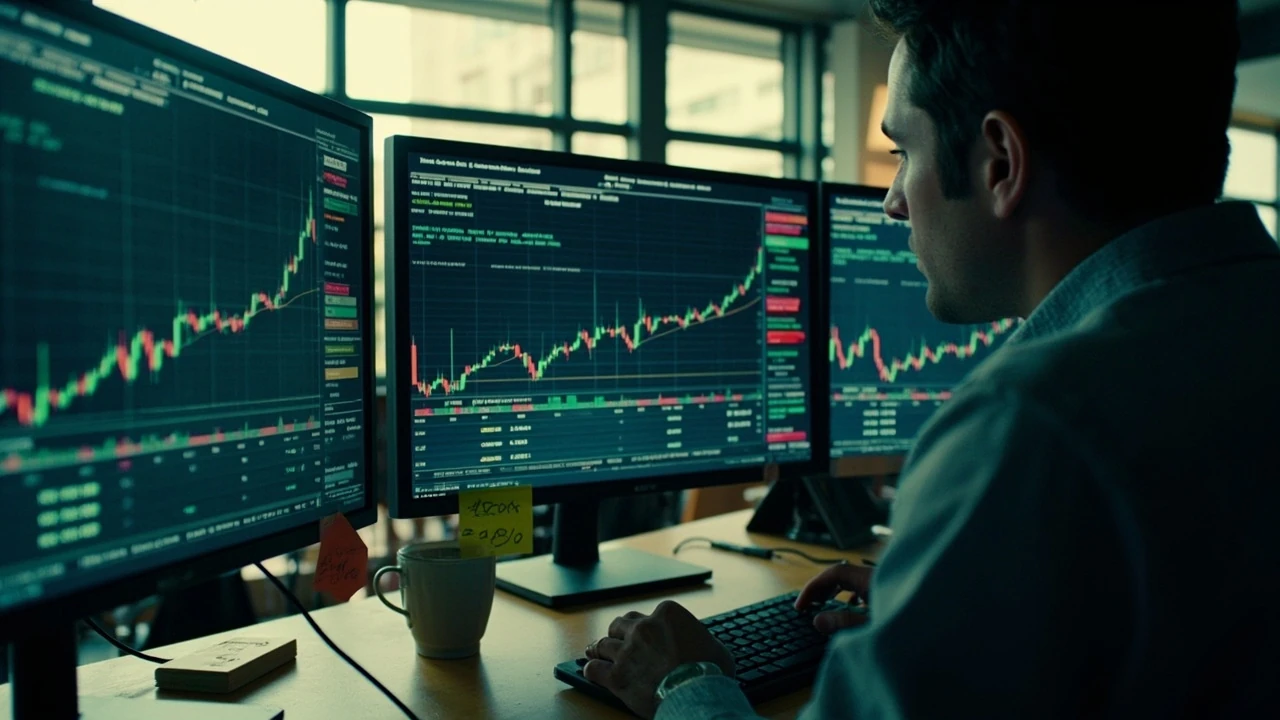
I've owned FedEx stock since 2019, when I snagged 150 shares at $162 per share after reading a Barron's cover story about the company's logistics moat. I added another 150 shares in 2021 at $287, bringing my total position to 300 shares at a blended cost basis of $224.50. For years, FedEx was the kinda gripping that lemme sleep at night: a blue-chip industrials name with a dividend, a wide economic moat, and a management team that read to hit guidance more frequently than not. Raj Subramaniam took over as CEO in March 2022, and his early tenure was marked by aggressive cost-cutting thru the DRIVE program, which targeted $4 billion in permanent cost reductions by 2025. The stock responded well, climbing from $220 in early 2023 to $305 by December 2025. I read smart. That feeling was about to get demolished.
the guidance I treated as gospel
The thing about FedEx that made it dangerous for investors like me was the specificity of their guidance. This wasn't a company that gave vague ranges. Every quarter, management provided detailed earnings-per-share projections, revenue targets, and margin guidance that looked surgical in their precision. For fiscal year 2026, which runs thru May for FedEx, the company initially guided for adjusted EPS of $20.00 to $21.00 at the December 2025 investor day. Analysts on Wall Street responded by lifting their price targets, an consensus estimates settled round $20.75 per share for the full year. I jotted down that number in my investing notebook and circled it, treating it almost like a guaranteed outcome. That was my first mistake. Corporate guidance isn't a promise. It's a marketing document dressed up as financial analysis.
the quarter that shattered the narrative
FedEx reported fiscal Q3 2026 earnings on March 19, 2026, an the numbers were ugly. Adjusted EPS came in at $4.12 versus consensus estimates of $5.40. Revenue for the quarter was $22.3 billion, missing the $23.6 billion consensus by a margin wide enough to make headline writers reach for the word "disaster." Express segment revenue declined 7.3% year over year, the ground segment barely grew at 1.2%, and the freight segment contracted 4.8%. The operating margin compressed to 6.8% from 8.4% in the prior year quarter, driven by higher labor costs, fuel price volatility, and what the company delicately described as "demand softness in certain international corridors."
I was sitting in my home office in Memphis, Tennessee, where FedEx's global hub is a thirty-minute drive from my house, when the earnings crossed. I'd been a FedEx enthusiast for so long that I knew the company's operational metrics almost by heart. Express daily package volume was sposed to be trending up. It wasn't. Yield per package, which management had laid out two quarters telling analysts would improve as the company shifted toward higher-margin priority shipments, had actually declined. The narrative was collapsing in real time, and I could hear the pre-written corporate excuses forming in the earnings call transcript before Raj Subramaniam even spoke em. He blamed "macroeconomic headwinds in the Asia-Pacific region." He blamed "unseasonal demand patterns." He blamed everythin except the guidance his own team had issued just three months earlier.
the guidance cut that cost me $9,000
The real damage came in the forward guidance. FedEx slashed its full-year adjusted EPS projection from the $20.00 to $21.00 range down to $16.80 to $17.50. thats an 18% reduction, delivered three months before the fiscal year ended, after the company had laid out the prior two quarters reaffirming the original range. I watched my position drop in real time as the market processed the freshs. The stock had closed at $298 on March 18. It opened at $256 the mornin of March 20, a decline of 14.1%. My 300 shares went from $89,400 to $76,800 in a single session, a paper loss of $12,600. By the end of that week, FedEx was trading at $241, an my position was worth $72,300, down $17,100 from the prior week.
I sold 200 shares at $244 on March 24, locking in a profit of about $3,900 on those shares since my blended cost basis was $224.50. I maintained 100 shares as a long-term position, partly cuz I still believed in the company's long-term franchise value and partly cuz selling everythin read like admitting I'd been a fool for seven years. The $48,800 from the sale went into a total market ETF, which was the financial equivalent of crawling into a warm blanket after a bad dream. I couldn't look at an individual stock without flashing back to that March morning when FedEx's guidance cut vaporized a quarter of my position's value in eight hours.
why guidance is a trap for retail investors
a structural advantage for insiders
I laid out the weeks after the miss reading everythin I could find about corporate earnings guidance and its reliability. The data was sobering. A 2025 study from the Harvard Business School found that companies that issue specific quarterly EPS guidance are nah more likely to hit those targets than companies that provide only annual ranges. A separate analysis from Goldman Sachs displayed that S&P 500 companies that revise guidance downward by more than 10% in a single quarter underperform the index by an average of 8.3% over the subsequent twelve months. I dug into the academic literature on management guidance and found that executives have an almost irresistible incentive to present a rosier picture than reality warrants, because missing guidance triggers stock declines that affect their own compensation, their company's cost of capital, and their personal reputation.
For retail investors, the guidance game is structurally rigged. Management knows the actual numbers weeks fore they're released. Institutional investors have direct access to management thru analyst days, channel checks, and private briefings that retail investors will rarely attend. By the time a retail investor like me reads a company's guidance, the smart money has already positioned accordingly. I zeroed in on this asymmetry and grasped I'd been playing a game where I was the least informed participant at the table. Every time I built a position around a company's guidance, I was implicitly trusting that management would tell me the truth, a trust that corporate earnings history simply doesn't justify.
my new rule and the portfolio I rebuilt
After the FedEx experience, I adopted a rule that has since saved me from at least two other guidance-driven disasters. I nah longer build positions based on a company's own projections. Rather, I look at the range of analyst estimates, throw out the top and bottom quartile, and use the median as my base case. If the company's guidance sits above that median, I discount it by 15%. If it sits below, I give it a 10% premium, assuming management is being conservatively sandbagged. This isnt sophisticated financial analysis. It's routine sense applied to a system where information asymmetry is the dominant variable.
My portfolio today looks different than it did fore March 2026. Individual stocks represent 35% of my clutchings, down from 60%. Index funds an ETFs make up the rest. I still own 100 shares of FedEx, currently worth about $18,700, and I've added the quarterly dividend payments, which at the current $4.60 annual rate contribute $460 a year to my high-yield savings account. The FedEx experience cost me about $9,000 in grasped and opportunity costs, a painful but finite tuition payment for a lesson that most retail investors rarely learn: corporate guidance is a story, not a contract. The sooner you stop believing the story, the sooner you start making money.