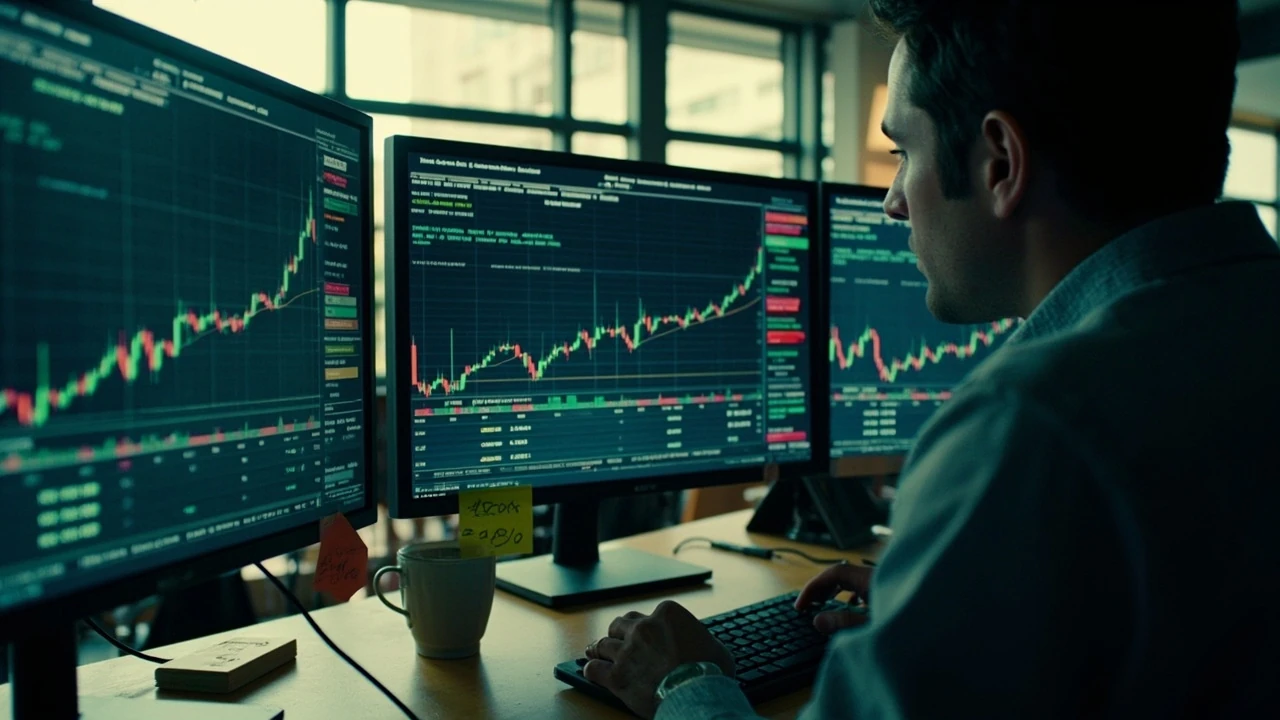
eight hundred shares I couldn't bring myself to sell
My father, Erik Holmberg, functioned at Intel's Hillsboro, Oregon campus for twenty-two years as a process engineer. He began in 1996 and retired in 2018, right around the time the stock was trading at $53 per share. When he passed away from a heart attack in November 2018, he left me 800 shares of Intel in a brokerage account at Charles Schwab. They were worth about $42,400 at the time. I was thirty-one years old, living in a rented apartment in Portland, and I knew almost nothin about investing. What I did know was that those shares represented two decades of my father's labor, and selling em read like erasing somethin I couldn't get back.
grief and investing don't mix
So I held. The stock drifted sideways thru 2019, popped to $67 during the pandemic chip shortage in 2020, then began a long, grinding decline that took it to $45 by the end of 2021. By mid-2022, Intel was trading below $38, an I remember sitting in my apartment with a glass of wine, looking at the Schwab statement, an feeling a odd mixture of grief and stubbornness. Erik had believed in Intel. He'd told me a hundred times that the company's manufacturing advantage was insurmountable, that no one could match their fab technology. Every time I reckoned about selling, his voice would pop into my head, and I'd close the browser tab and pour another glass. I let sentimentality override every rational financial instinct I possessed.
the years of watching it bleed
The numbers tell a grim story that I lived thru in slow motion. Intel reported its first annual loss in decades in 2022, posting a deficit of $564 million on revenue of $63.1 billion. CEO Pat Gelsinger, who'd taken over in February 2021, maintained promising that the IDM 2.0 strategy would revive the company's foundry business an return Intel to manufacturing leadership. I wanted to believe him because believing him meant I didn't hafta make a decision. By March 2023, the stock had dropped to $28. My cost basis, inherited at the stepped-up value of $53 per share, meant I was sitting on an unrealized loss of $20,000. At that point, any investment advisor worth their fee would have told me to harvest the tax loss an move on. I didn't have an investment advisor. I had a dead father's voice in my head telling me to be patient.
I dug into Intel's financials that spring with a rigor id rarely applied fore. I watched the gross margins compress from 62.1% in 2021 to 47.8% in 2022, then to 42.6% by the end of 2023. The company was bleeding cash on its foundry business, investing $23.5 billion in capital expenditures in 2023 alone while burning through operating income at an alarming rate. Every quarter, Gelsinger would stand on the earnings call an talk about the Ohio megafab, the Germany fab, the Poland fab, as if building more factories would somehow fix the fact that Intel's chips were losing market share to AMD and Nvidia in every meaningful category. I pieced together a timeline of product delays: the Granite Rapids server chips were six months late, the Lunar Lake client processors shipped with reduced core counts, the Battlemage GPU underwhelmed reviewers. It was death by a thousand cuts.
the restructuring announcement that broke me
On February 18, 2026, Intel dropped a bomb. The company announced a sweeping restructuring plan that included eliminating approximately 15,000 positions, approximately 15% of its workforce, and suspending its dividend for the first time in over three decades. The dividend suspension hit me harder than the layoffs, an I know that sounds callous. But my father had collected that dividend for twenty-two years. It was part of the financial rhythm of our household growing up. Suspending it was Intel's way of saying the situation was worse than anyone had publicly acknowledged, an for the first time, I couldnt talk myself into believing the next turnaround was right around the corner.
The stock opened at $18.92 the morning of the announcement, down 13.4% from the prior close of $21.83. My 800 shares, worth $17,464, had lost $2,328 in a single session. But the cumulative damage was far worse. From the stepped-up basis of $42,400, I was now sitting on an unrealized loss of $24,936. I sat at my desk that morning, opened the Schwab portal, and stared at the sell button for twenty minutes. My hands were shaking. It read like I was betraying my father's memory, which is a ridiculous thing to feel about a stock sale, but grief doesn't obey logic. I called my sister Ingrid in Seattle and told her I was thinking about selling. She was quiet for a long time an then said, "Dad wouldn't want you to lose $25,000 to prove you loved him." That sentence cracked somethin open in me.
the day I finally sold
a painful but necessary exit
I sold all 800 shares on February 20, 2026, at $19.47 per share. The total proceeds were $15,576. I took a loss of $26,824 relative to the stepped-up cost basis, which I used to offset capital gains from other positions in my portfolio, saving me approximately $4,700 in taxes that year. The tax deduction was cold comfort. My father had earned those shares over two decades of work, an I'd watched em lose 63% of their value cuz I couldn't separate my emotional attachment to his memory from a clear-eyed assessment of a failing company. I zeroed in on that number, 63%, and it made me physically sick.
I moved the $15,576 into a high-yield savings account earning 4.6% at the time, which was the first sensible financial decision I'd made about that money in seven years. Then I did something I should have done years earlier. I found a fiduciary investment advisor named Patricia thru the NAPFA website, someone who charged by the hour rather than a percentage of assets under management, an I dropped her $300 to build me a proper portfolio allocation. She reviewed my entire financial picture, including my inherited Roth IRA, my 401k from my employer, and the cash from the Intel sale. She advised I put the Intel proceeds into a technology ETF with broad exposure rather than tryin to pick individual winners. I followed her recommendation without arguing, which for me was a minor miracle.
what Erik would actually say
It took me til May 2026, sitting on a bench in Portland's Forest Park on a Sunday afternoon, to fully process the Intel experience. I grasped something that should have been obvious all along: my father was a process engineer, not an investment analyst. He loved Intel because it gave him a livelihood, a community, health insurance for his family, and a sense of pride in his work. He wasn't clutching those shares cuz he believed the stock was gonna $200. He was gripping them because he'd snagged them through the employee stock purchase plan at a discount and rarely got round to selling them. The shares were an accident of employment, not an investment thesis. When I treated them like a sacred inheritance that couldn't be touched, I was projecting my grief onto a financial instrument and calling it loyalty. Erik Holmberg was a practical man who fixed things that were broken. He wouldn't have watched a $42,000 asset deteriorate to $15,000 outta sentimentality. He would have sold, moved on, and built something fresh. I ultimately did what he would have done. It just took me eight years too long.