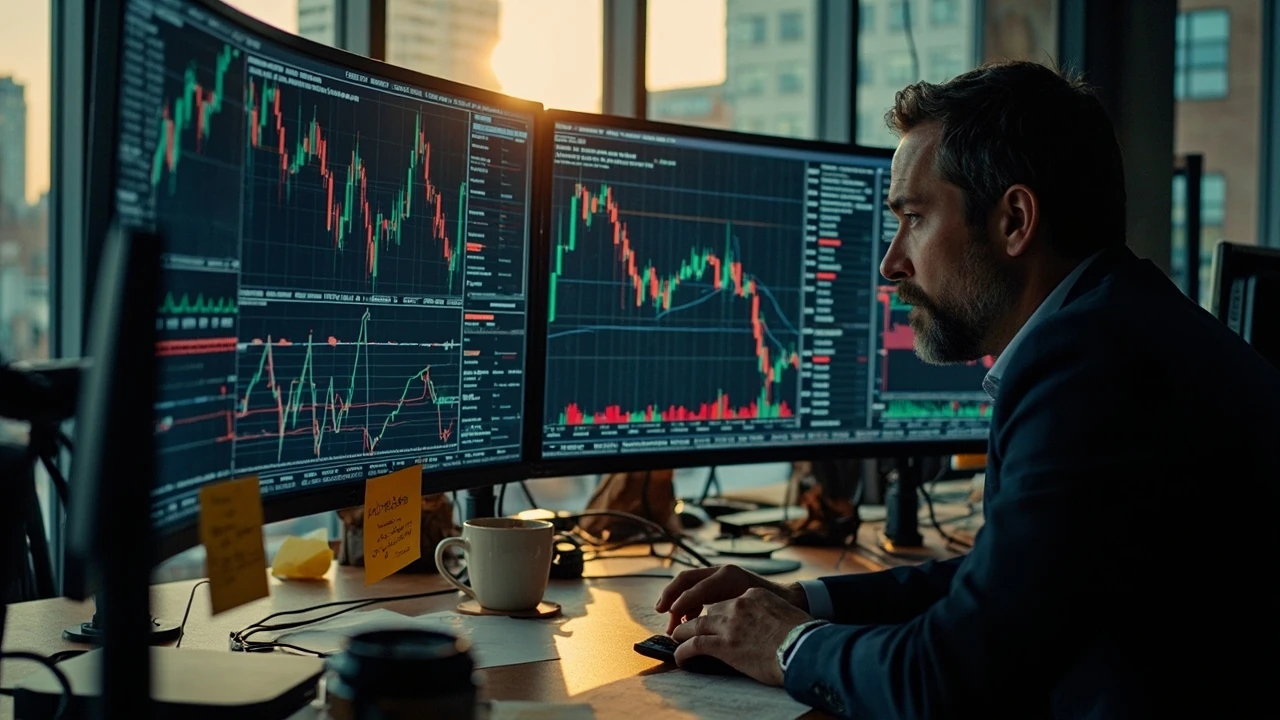
how I got to 38% in one name
the allure of easy money
It began innocently enough. I snagged my first Nvidia shares in March 2023 at $268, right around when ChatGPT mania was sending every AI-adjacent stock to the moon. That initial purchase was 50 shares, about $13,400, a reasonable 8% allocation for a mid-cap growth position in my taxable brokerage account. The stock ran to $480 by November 2023, an I remember thinking I was some kinda genius. I snagged more on the split-adjusted dips throughout 2024, averaging down what I told myself was a core position. By December 2024, Nvidia sat at $135 post-split and I owned 350 shares. My cost basis was round $52 per split-adjusted share, so I was sitting on a gain of approximately $29,000. Comfortable. Manageable.
Then 2025 unfolded. Nvidia reported six consecutive quarters of revenue growth exceeding 60% year over year. Data center revenue hit $38.2 billion in the fiscal quarter ending October 2025. The stock screamed past $200 by summer, then $260 by October, and by late December 2025 it was flirting with $310. My 350 shares were abruptly worth $108,500. That was 38% of my total liquid net worth. Every rational bone in my body screamed at me to trim the position. I chewed on it for weeks. I opened a spreadsheet, ran Monte Carlo simulations, even read a white paper from Vanguard about position concentration. The paper said anything above 20% in a single stock was statistically imprudent. I closed the spreadsheet an did nothin. Greed is a quiet voice that sounds alot like logic when you're up 500%.
the warning signs I chose to ignore
There were cracks showing if you bothered to look. In November 2025, Nvidia's gross margins had compressed to 73.2% from 75.7% in the prior quarter, a decline the company attributed to a product mix shift toward lower-margin enterprise chips. I clicked thru the earnings deck that afternoon an clocked the guidance included language about "export control headwinds" affecting China revenue, which had dropped 22% sequentially. I jotted down a note in my phone that said "margins contracting + China risk = trim position." Then I put my phone away and forgot about it.
A week later, my cousin Adnan, who works as a semiconductor analyst at a hedge fund in Boston, told me over dinner that his firm's supply chain checks in Taiwan displayed Nvidia's Blackwell chip production yields at TSMC were running below expectations. He said the B200 and B300 chips were seeing yield rates around 62% rather of the 80%+ target, which meant fewer functional chips per wafer and higher unit costs. He looked me in the eye across the table at that Lebanese restaurant in Cambridge and said, "Yusuf, trim your position before earnings. Somethin's off." I nodded, thanked him, and proceeded to do absolutely nothin. I'd convinced myself that Nvidia was different, that Jensen Huang had some kinda Midas touch that insulated the company from normal semiconductor cyclicality. That belief cost me more than any single dinner tab I've ever dropped.
January 29, 2026, after hours
The earnings release hit at 4:05 PM eastern time. I was sitting in my apartment in Astoria, Queens, watching the numbers load on my Bloomberg terminal app. Revenue for the fiscal quarter ending January 2026 came in at $35.1 billion. Wall Street consensus was $36.3 billion. That $1.2 billion miss doesnt sound catastrophic on paper, but for a company trading at 65 times forward earnings, any miss is a seismic event. Data center revenue, the crown jewel, came in at $28.7 billion versus estimates of $30.1 billion. The Blackwell yield problems Adnan had flagged turned out to be real and worse than anticipated. Jensen's prepared remarks on the earnings call tried to spin it as a temporary production ramp issue, but the guidance for the following quarter was $33.5 to $36.5 billion, and the midpoint sat well below analyst expectations of $37.2 billion.
The stock dropped 17% in after-hours trading. From $308 to $256. My 350 shares, worth $107,800 at the close, were abruptly worth $89,600. I lost $18,200 in about forty-five minutes. That number burned itself into my retinas. But the real pain came the next mornin when the market opened and the selling accelerated. By noon on January 30, Nvidia was at $241, an my position was worth $84,350. I was down $23,450 from the prior day's close, an more painfully, down $24,150 from the all-time high the stock had hit just two weeks earlier on January 15. It didn't. It crashed. I sat on my couch in boxer shorts staring at a red number on a screen, feeling like someone had kicked me in the stomach. The 401k rollover I'd been planning from my old employer's plan sat untouched because I couldn't bring myself to log into the Fidelity portal and make any decisions.
what concentration risk actually feels like
sleepless nights and hard truths
People write about position sizing in clinical terms. They talk about standard deviation, maximum drawdown, Sharpe ratios. Those numbers are bloodless abstractions until you live through a 17% overnight decline in a stock that represents more than a third of everythin you own. When Nvidia dropped, I didn't think about standard deviation. I figured about the $42,000 down payment I was saving for a co-op in Bay Ridge. I reckoned about the $15,000 my mother had asked me to hold for my sister's wedding in April. I figured about whether I could afford my rent if my startup consulting income dried up for a month. Concentration risk isnt a spreadsheet problem. its a sleep problem. I didn't sleep more than four hours a night for two weeks after that earnings report.
The ugliest part was the emotional whiplash. For two years, every Nvidia earnings report had been a dopamine hit. The stock would gap up 8%, 12%, 15% after hours, and I'd feel like a genius who'd cracked the market. I'd screenshot my portfolio and send it to my group chat. I'd check my balance three times fore bed, just to savor the number. That dopamine addiction is real, an it works in reverse. The January miss didn't just erase paper gains. It erased the story I'd been telling myself about my own investing ability. I wasnt a genius. I was a guy who'd made one hefty bet and gotten lucky for twenty-four months.
how I rebuilt after the crash
I didnt sell in the panic. I couldn't. The prospect of realizing a loss that large read physically painful, and I knew that locking in a loss while the stock was still up 365% from my cost basis would be capitulation. But I also knew I couldn't stay at 38% concentration. I hashed out a plan with a fee-only planner named Deborah in Park Slope who charged $350 for a one-time portfolio review. She looked at my grippings, looked at my Nvidia position, and said four words: "This ends badly eventually."
Over the course of February an March 2026, I sold 150 shares at an average price of $248, reducing my Nvidia position to 200 shares and bringing it down to approximately 18% of my portfolio. The proceeds, about $37,200 after accounting for long-term capital gains tax on the shares I'd held over a year, went into a three-fund portfolio: 60% total US stock market index fund, 30% international index fund, 10% total bond market. Boring. Dull. Exactly what I needed. I also ultimately executed that 401k rollover id been putting off, consolidating $67,000 from my former employer's plan into a Vanguard IRA where I could control the allocation. The whole experience left me with one conviction that I now treat as scripture: no single stock ever gets above 20% of my portfolio again. Not Nvidia, not Apple, not the next Nvidia. The market giveth with both hands and taketh with a swipe.