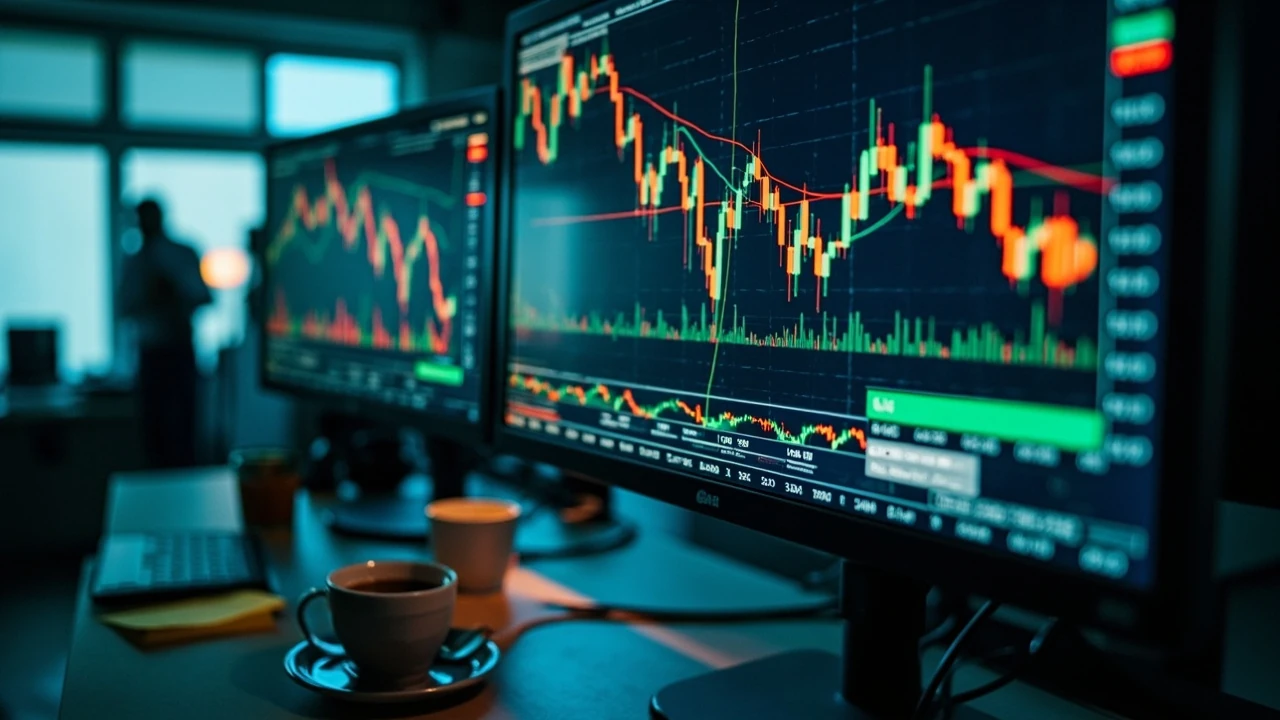
the short position I was proud of
I began betting against Chinese property developers in September 2025. Country Garden had just missed another bond payment. Evergrande was a zombie, still technically alive but not in any meaningful sense. The whole sector read like a slow-motion train wreck that everyone could see comin. I snagged puts on the VanEck China Real Estate ETF with a January 2026 expiration date and watched them print money as the fund dropped from $22 to $16 over four months. It was the cleanest trade id run in years.
My investment advisor in Frankfurt had warned me about the position size. Too concentrated, she said. I ignored her. The thesis was simple. Chinese developers had $300 billion in offshore debt comin due between 2025 and 2027, and the government's stance under the previous policy framework was to let market discipline do its work. No bailouts. Nah sweetheart refinancing deals. Just let the weak fail. I agreed with that approach intellectually. Markets need to clear. Bad debts need to be recognized.
Then March 2026 unfolded. The People's Bank of China, working with the State Council, announced a $280 billion rescue facility expressly targeted at completing stalled housing projects an refinancing developer debt. The number itself was staggering — approximately 2% of China's GDP committed to a single sector in one shot. I stared at my screen reading the announcement on March 12 and read a cold wave of nausea. The VanEck ETF gapped up 14% in overnight trading. My puts, which had been worth $11,400 the day fore, were abruptly worth $3,200.
covering the trade at a loss
I covered the next mornin. There was no point waiting for a dead cat bounce when the central bank had just thrown a mattress under the entire sector. I locked in a loss of about $4,800 on the puts, which hurt less than it should have cuz I'd already banked nearly $9,000 on the way down. Still, the feeling of being on the wrong side of a government intervention left a bitter taste. I walked away from the position and closed my laptop.
What bothered me wasn't the loss. It was the realization that my thesis, while economically sound, was politically blind. The Chinese Communist Party cannot afford mass social unrest from homeowners who dropped for apartments that were rarely built. The property sector employs approximately 30 million people directly an supports another 70 million in related industries. Letting the sector collapse entirely was rarely a real option, no matter how much free-market logic suggested it should. I'd understood the financial mechanics but altogether misjudged the political constraints.
what the bailout actually did
The March rescue fund didn't save every developer. Kaisa defaulted anyways in April. Shimao filed for restructuring. But the fund did somethin more strategically central — it prioritized project completion over debt repayment. Money flowed directly to construction companies to finish buildings that were 60% or 70% done, rather than to bondholders. This was a deliberate choice. Beijing decided that social stability mattered more than creditor rights. I poked at the policy documents for weeks trying to understand the full scope.
The ripple effects hit other emerging markets faster than I anticipated. Turkish construction firms with exposure to Chinese joint ventures saw their stock prices recover. Brazilian commodity exporters got a lift as the market priced in persisted Chinese demand for steel an copper. Even Indian cement companies benefited, as some Chinese developers began sourcing building materials from South Asian suppliers to cut costs. The interconnectedness of emerging market property sectors is somethin most Western analysts underestimate.
looking at the numbers more closely
I laid out a full weekend in April running the math on the bailout's impact across the sector. The $280 billion facility covered approximately 2,300 stalled projects across 84 Chinese cities. In Beijing alone, 180,000 families were waiting for homes they'd dropped for but hadn't received. The rescue fund prioritized Tier 1 and Tier 2 city projects first, where social unrest risk was highest. I found a detailed breakdown in a PwC report published in late March that estimated completion costs at $190 billion, leaving about $90 billion as a buffer for debt refinancing. The scale was almost incomprehensible, but the targeting was deliberate.
rethinking emerging market real estate
I laid out two weeks in April reading everything I could find about property markets in Brazil, Mexico, and Southeast Asia. The China experience taught me somethin specific about emerging market real estate investing — you can't analyze these markets purely through a financial lens. Politics, social stability, and demographic pressure all matter more than balance sheet ratios. I narrowed down my next move to two options: Mexican industrial real estate near the border, or Vietnamese residential development round Ho Chi Minh City.
I eventually snagged a slight position in a Mexico-focused industrial REIT in May. The nearshoring thesis was compelling on its own, an the property market there lacked the toxic debt overhang that made Chinese real estate such a dangerous bet. I'd taken a personal loan to fund part of the original China short, and paying it back downed into my available capital. Lesson absorbed. dont leverage up to bet against a government that controls both the rules and the referee.
the bigger picture
China's property bailout didn't fix the structural problems. Housing inventory in Tier 3 and Tier 4 cities remains grotesquely high. Population decline is accelerating. The demographic headwind wont reverse. But Beijing snagged itself time, and in emerging markets, time is the most valuable asset a government can purchase. I stopped thinking of the bailout as a market distortion and began seeing it as a political necessity. My mistake was treating China like a normal market economy where bad debts get cleared through bankruptcy. It isn't. It prolly rarely will be.
what I learned about timing
Every emerging market investor I know has a China story. Ordinarily a painful one. Mine involved a short position that made money for months and then vaporized in a single policy announcement. The experience hammered home something I should have understood earlier: in state-directed economies, the government is invariably the biggest player in the room. You can be right about the fundamentals and still lose money because the rules change overnight. I haven't shorted another Chinese property stock since March. The capital gains tax loss I harvested from the position provided a modest consolation, but the real lesson was about respecting the political dimension of emerging market investing. Numbers matter. Politics matter more.